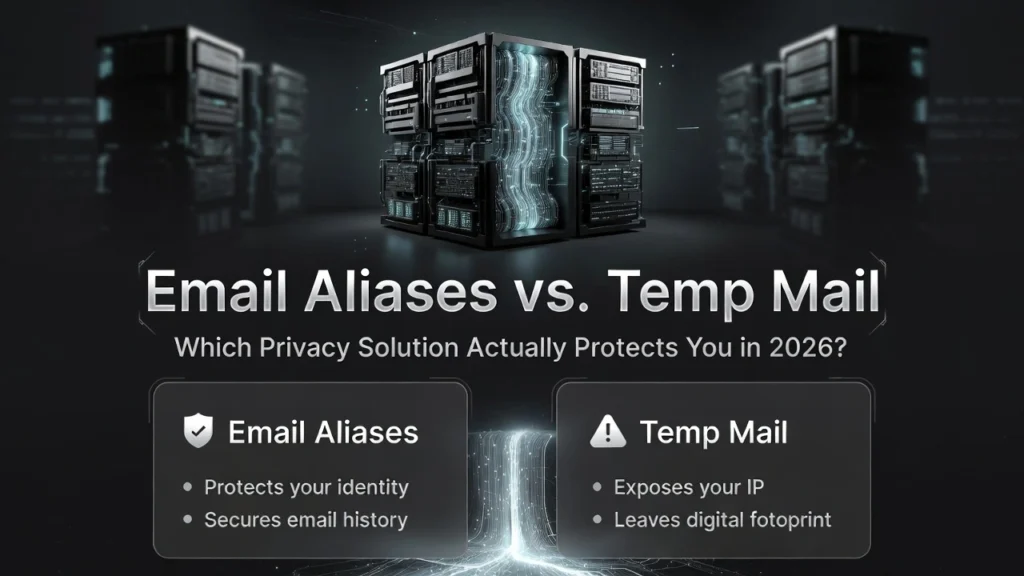

In the surveillance-driven web of 2026, your email address is no longer just for communication—it’s the linchpin identifier that data brokers use to stitch together your entire digital life. The battle for privacy has crystallized around two tools: persistent email aliases and volatile temporary mail. After a technical deep dive, the verdict is clear: for long-term protection and identity control, advanced email alias services like ProtonMail, Apple Hide My Email, and SimpleLogin are vastly superior. Temporary mail remains a useful but high-risk tool for truly anonymous, one-time tasks.

The 2026 Identity Crisis: Why Your Old “+Sign” Trick is Now Useless
For years, privacy-conscious users relied on subaddressing (e.g., `[email protected]`). In 2026, this method is technologically obsolete for privacy. Any data broker’s script can instantly strip the text after the “+” to reveal your root address, re-aggregating all the data you tried to compartmentalize.
- Old Method (Subaddressing): Simple tagging. High exposure risk. Easily reversed.
- New Paradigm (Aliasing): True identity virtualization. Independent addresses that relay mail.
The failure of subaddressing forced a shift from simple “tagging” to full “virtualization,” making true email aliases the foundation of modern privacy defense.
How Email Aliases Work: The SMTP Relay Engine Protecting Your Inbox
An alias service isn’t an inbox; it’s a smart mail relay. When an email is sent to your alias, the service’s server accepts it, looks up your real address in a secure database, and forwards the message. The sender never sees your primary email.
The genius is in bidirectional communication via Reverse Aliases. To reply, you send from your main inbox to a unique reverse address provided by the alias service. The service then strips your personal details and delivers the reply, making it appear to come from your alias.

ProtonMail Aliases & SimpleLogin: Encryption and Open-Source Power
Proton’s ecosystem (via Proton Pass and SimpleLogin) offers the most technically robust solution for power users. SimpleLogin’s open-source model allows self-hosting, and its support for custom domains (e.g., `[email protected]`) provides portable identity control.
- Key Strength: PGP encryption can be applied during forwarding, ensuring content is unreadable even to the relay service.
- 2026 Reality: Services impose ~25MB size limits due to the computational load of real-time encryption.
Apple Hide My Email: Seamless Ecosystem Privacy
Deeply baked into iOS and iCloud+, Apple’s solution is privacy for the masses. Its “Designated Sender” protocol is a game-changer: each alias only accepts mail from the specific app or website where it was created, nullifying its value if leaked to third-party spammers.
- Zero-Access Relay: Emails are deleted from Apple servers seconds after delivery to you.
- Mail Privacy Protection (MPP): Uses a dual-hop relay to hide your IP address and pre-load tracking pixels, rendering “open rate” metrics useless for marketers.
Temporary Mail in 2026: High Volatility, High Anonymity, High Risk
Services like Temp-Mail provide a random, session-based inbox that evaporates. Their sole advantage is perceived anonymity with no link to your identity. However, this comes at a severe cost.
- Recovery Lockout Catastrophe: Using a burner for any account you might need to recover (e.g., social media, banking) means permanent access loss once the inbox expires.
- Weak Security: Inboxes are often public or easily guessed, with messages stored unencrypted on shared servers.
- Heuristic Detection: Modern sites use MX record analysis and domain age checks to instantly block known temporary mail domains.
Temporary mail is a digital paper cup: useful for a single sip, but a terrible foundation for anything you need to last.
Head-to-Head: Which Tool Wins for Key Privacy Goals?
Choosing the right tool depends on your specific threat model and use case in 2026.
Goal: Long-Term Account Management & Breach Containment
Winner: Email Aliases. A unique alias for every service acts as a firewall. If a site is breached, you simply disable that single alias. This prevents credential stuffing attacks and stops spam at its source without affecting your primary inbox or other accounts.
Goal: Maximum Anonymity for a One-Time Download
Winner: Temporary Mail. For accessing a single PDF or bypassing an annoying “sign-up wall” on an untrusted site, a disposable inbox provides a layer of separation with almost zero setup. Just never use it for anything requiring future access.
Goal: Stopping Email Trackers and Marketing Surveillance
Winner: Apple Hide My Email + Mail Privacy Protection. This combo is unmatched. Aliases hide your real address, while MPP’s background proxy rendering neutralizes pixel tracking and IP-based fingerprinting, fundamentally breaking the marketer’s surveillance toolkit.
The 2026 Strategic Framework: A Tiered Defense for Your Digital Identity
Experts now advocate a layered “Defense-in-Depth” strategy. Your identity is not monolithic; it should be segmented based on risk and necessity.
- Tier 1: Core Identity (Primary Email): For absolute critical services only: primary banking, government IDs, and account recovery. Protect with hardware security keys (FIDO2).
- Tier 2: Managed Identity (Email Aliases): The workhorse layer. Use a unique alias for every online account, newsletter, and store. Use custom domains for high-value, portable identities.
- Tier 3: Anonymous Identity (Temporary Mail): The disposable layer. Use exclusively for one-off interactions where no relationship or future access is needed.
In 2026, privacy isn’t about having one perfect tool; it’s about strategically deploying the right tool for each specific layer of your digital life.
Final Verdict: What Actually Protects You in 2026?
The landscape is clear. For comprehensive, long-term privacy that balances security, convenience, and control, advanced email alias services are the definitive winner. They provide persistent virtualization of your identity, robust breach containment, and are evolving with features like integrated encryption.
Temporary mail retains a narrow, high-risk utility for absolute anonymity in ephemeral scenarios. The greatest modern threat isn’t just spam—it’s Agentic AI phishing and Adversary-in-the-Middle attacks that can bypass even the best alias. Therefore, your ultimate protection in 2026 is a combination of a disciplined, tiered alias strategy and phishing-resistant multi-factor authentication.