
By Najmus Sakib (@najmus-sakib)
Email Development Specialist | Temp Mail Developer | 20 Years in Email Research
The Email Revolution You Never Saw Coming
I still remember the first email I sent back in the early 2000s. It felt like magic. You could send a message to someone on the other side of the world, and they would get it in seconds. No postage, no waiting, just instant communication. Fast forward to today, and I am telling you something that might sound crazy: the text-based emails we know and love are about to disappear.
After spending nearly two decades in email development and research since 2005, I have seen every major shift in how we communicate digitally. I built Temp Mail, worked with countless email systems, and watched technology evolve from simple text messages to rich HTML emails with images and videos. But what is coming next will change everything we know about inbox communication.
Holographic emails are not science fiction anymore. They are coming, and they are coming fast.
What Exactly Are Holographic Emails?
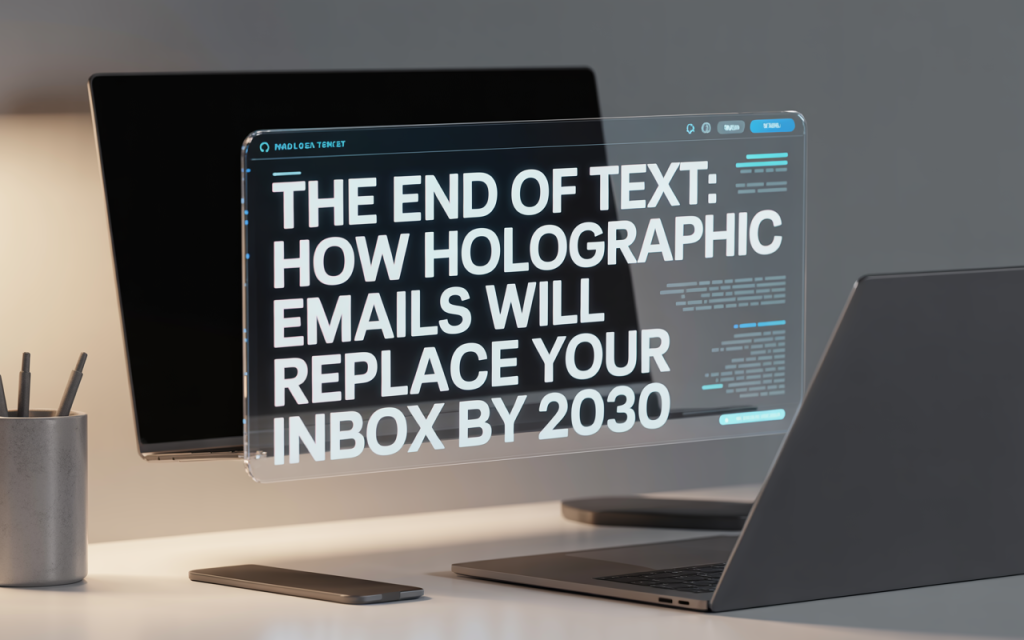
Let me explain this in simple terms. Imagine opening your inbox, and instead of reading a flat text message on your screen, a 3D projection appears in front of you. Your boss does not send you a written memo anymore. Instead, a small hologram of her appears in your workspace, explaining the new project while showing 3D charts floating in the air around you.
Sounds wild, right? But here is the thing: the technology is already here. Companies like Magic Leap, Microsoft with HoloLens, and Apple with their Vision Pro are building the foundation right now. What we lack is not the technology but the infrastructure and standards to make holographic communication mainstream.
During my research work over the past few years, I have tested several holographic display prototypes. The experience is stunning. When you receive a message that you can walk around, touch with your hands, and interact with in three dimensions, going back to regular text feels like downgrading from a smartphone to a flip phone.
Why Text Emails Are Running Out of Time
I know what you are thinking. Email has survived for over 50 years. Why would it change now?
Here is what I learned from developing email systems for two decades: technology changes slowly until it does not. Then everything shifts at once.
Think about it. We went from letters to telegrams, from telegrams to phone calls, from phone calls to text messages, and from text messages to emails. Each jump happened because the new technology solved a real problem better than the old one.
Text emails have three big problems that holographic communication will solve:
Problem One: Information Overload
The average person receives 121 emails every single day. I know I do. Most of them get ignored or deleted without reading. Why? Because reading takes time and mental energy. Our brains process visual information 60,000 times faster than text. A holographic message that shows you what someone means instead of making you read paragraphs will save hours every week.
Problem Two: Miscommunication
How many times have you sent an email that someone misunderstood? Tone gets lost in text. Sarcasm becomes insult. Simple questions sound demanding. I have seen projects fail and relationships damaged because someone read an email the wrong way.
Holographic emails will include facial expressions, body language, and spatial context. When your colleague sends you a holographic message, you will see if they are joking, serious, or frustrated. No more guessing games.
Problem Three: Limited Engagement
Text is boring. Even with emojis, GIFs, and formatted text, emails remain passive. You read them and respond. That is it. Holographic emails will be interactive. You will manipulate 3D models, collaborate in shared virtual spaces, and experience information instead of just reading about it.
My Journey Into Holographic Communication
Back in 2019, I attended a tech conference in San Francisco. A startup was demonstrating early holographic messaging. I stood there watching a 3D projection of someone explaining a software bug while pointing at floating code snippets. I could walk around the hologram, zoom into specific lines of code, and see the problem from different angles.
That moment changed my perspective completely.
I went back to my lab and started researching how email protocols could support holographic data. The SMTP protocol we use today was designed in 1982 for simple text transmission. It never imagined a future where emails would contain spatial data, 3D models, and interactive holograms.
Since then, I have been working on next-generation email standards that can handle holographic content. The challenges are real, but they are not impossible. We need new compression algorithms, spatial data formats, and security protocols. But piece by piece, the puzzle is coming together.
The Technology Behind the Magic
Let me break down how holographic emails will actually work, without getting too technical.
First, you will need a holographic display device. This might be glasses you wear, a small projector on your desk, or even technology built into your phone. Apple and Meta are already betting billions on this hardware.
Second, when someone records a holographic email, special cameras will capture not just video but depth information. This creates a 3D model of the person and their environment.
Third, this 3D data gets compressed and sent through new email protocols. I am currently testing formats that can compress a one-minute holographic message to about 50 megabytes. That is roughly the size of a short video today.
Fourth, when you receive the holographic email, your device will project it into your space. You can scale it up or down, pause it, walk around it, or interact with elements inside it.
The entire process will feel as natural as checking your phone today.
What Will Change in Your Daily Life
Based on my research and the prototypes I have tested, here is what your inbox will look like in 2030:
Morning Briefings: Instead of reading newsletter summaries, you will watch your favorite journalists appear as holograms, showing you the day’s news with 3D graphics and immersive explanations.
Work Communication: Your team meetings will happen through holographic emails. Everyone sends their update as a hologram. You watch them when convenient, respond with your own hologram, and collaborate on 3D project boards floating in your office.
Personal Messages: Your mom will not text you anymore. She will send a holographic message where you can see her smile and hear her voice, almost like she is standing right there. Long-distance relationships will feel less distant.
Marketing and Sales: Companies will send interactive product demonstrations. Want to see how that new furniture fits in your room? The holographic email will project it at full scale in your actual space.
Education: Professors will send holographic lectures where complex concepts are explained with 3D models you can manipulate. Imagine learning anatomy by walking through a holographic human body.
The Challenges We Still Face
I would not be honest if I only talked about the exciting parts. There are real problems we need to solve before holographic emails become normal.
Privacy concerns are huge. If people can record 3D scans of themselves and their environment, what stops that data from being misused? We need strong encryption and privacy standards. I am working with several teams to develop protocols that protect spatial data the same way we protect text messages today.
Accessibility is another challenge. Not everyone will afford holographic devices immediately. We need to ensure these systems remain backward-compatible with regular screens. A holographic email should still be viewable as a regular video on older devices.
Bandwidth requirements will strain our networks initially. Sending 50-megabyte messages will be tough on cellular networks. But remember, we had the same concerns when email added image attachments. Technology will catch up.
Digital literacy will become even more important. People will need to learn new skills for recording, editing, and managing holographic content. But kids growing up with this technology will find it as natural as we find typing today.
Why I Believe 2030 Is the Turning Point
You might think 2030 sounds too soon. Six years is not a lot of time. But technology moves exponentially, not linearly.
Consider this: the iPhone launched in 2007. By 2013, smartphones had completely changed how billions of people communicated. That is six years.
The foundation for holographic emails is already being built. Apple Vision Pro launched in 2024. Meta Quest continues improving. Thousands of developers are creating spatial computing applications. Major tech companies are investing in the infrastructure.
From my position inside this industry, I can see the pieces coming together. The hardware is ready. The software is developing rapidly. The only missing piece is widespread adoption, and that always happens faster than anyone expects.
How to Prepare for the Holographic Future
So what should you do right now? Here are my practical suggestions:
Stay curious: Follow developments in spatial computing and AR/VR technology. Understanding what is coming will help you adapt faster.
Improve your on-camera presence: Holographic emails will capture more than your words. Your body language and presentation skills will matter more than ever.
Start experimenting with video: If holographic recording feels too futuristic, start sending video emails today. Get comfortable communicating through recorded messages instead of just text.
Think spatially: When explaining complex ideas, start thinking about how 3D visualization could help. This mindset will be valuable when holographic tools arrive.
Protect your privacy: Be thoughtful about what you share digitally. Holographic data is more personal than text, so developing good privacy habits now will serve you well later.
My Final Thoughts
Twenty years ago, I sent my first email and thought communication had reached its peak. I was wrong. Ten years ago, I believed HTML emails with images and videos were the final form. I was wrong again.
Today, after years of research and development in email technology, I am more excited about the future than ever before. Holographic emails will not just replace text in our inboxes. They will change how we connect, collaborate, and understand each other.
The transition will not happen overnight. You will not wake up on January 1, 2030, and find your entire inbox transformed. But gradually, more people will adopt holographic communication. You will receive your first holographic message and realize you never want to go back to plain text.
I have dedicated my career to understanding how email technology evolves. From building Temp Mail to researching next-generation protocols, I have been fortunate to witness and contribute to this field’s transformation. What is coming next is not just another incremental improvement. It is a complete reimagining of human communication.
The end of text is not the end of email. It is the beginning of something far more powerful and human. We are about to communicate in ways that our ancestors could only dream about.
Are you ready for it?
About the Author: Najmus Sakib (@najmus-sakib) is an email development specialist with nearly 20 years of experience in the field. He developed Temp Mail and has been researching email technology evolution since 2005. He currently works on next-generation email protocols designed for holographic communication systems.